9th IC-3Rs Symposium 2026
3Rs Beyond Boundaries: The 3Rs Across Disciplines
Friday 18 September 2026 from 9.30
Health Campus Jette • BUILDING A • Auditorium P. Brouwer • Laarbeeklaan 103 • 1090 Jette • Belgium
Biotechnology is increasingly recognised as a key driver for innovation across multiple sectors, ranging from biomedical research and pharmaceutical development to food production, consumer safety and industrial applications. While biotechnology has contributed for decades to the development of alternatives to animal use, the field of in vitro biotechnology is currently advancing rapidly through novel human-relevant models and technologies with broad applications in research, safety assessment and product development. This progress illustrates how the implementation of the 3Rs is no longer confined to a single discipline, but has become a cross-sector effort involving academia, industry, regulators and healthcare stakeholders alike.
The IC-3Rs symposium 2026 explores how the 3Rs are expanding “beyond boundaries” and influencing diverse scientific and industrial fields.
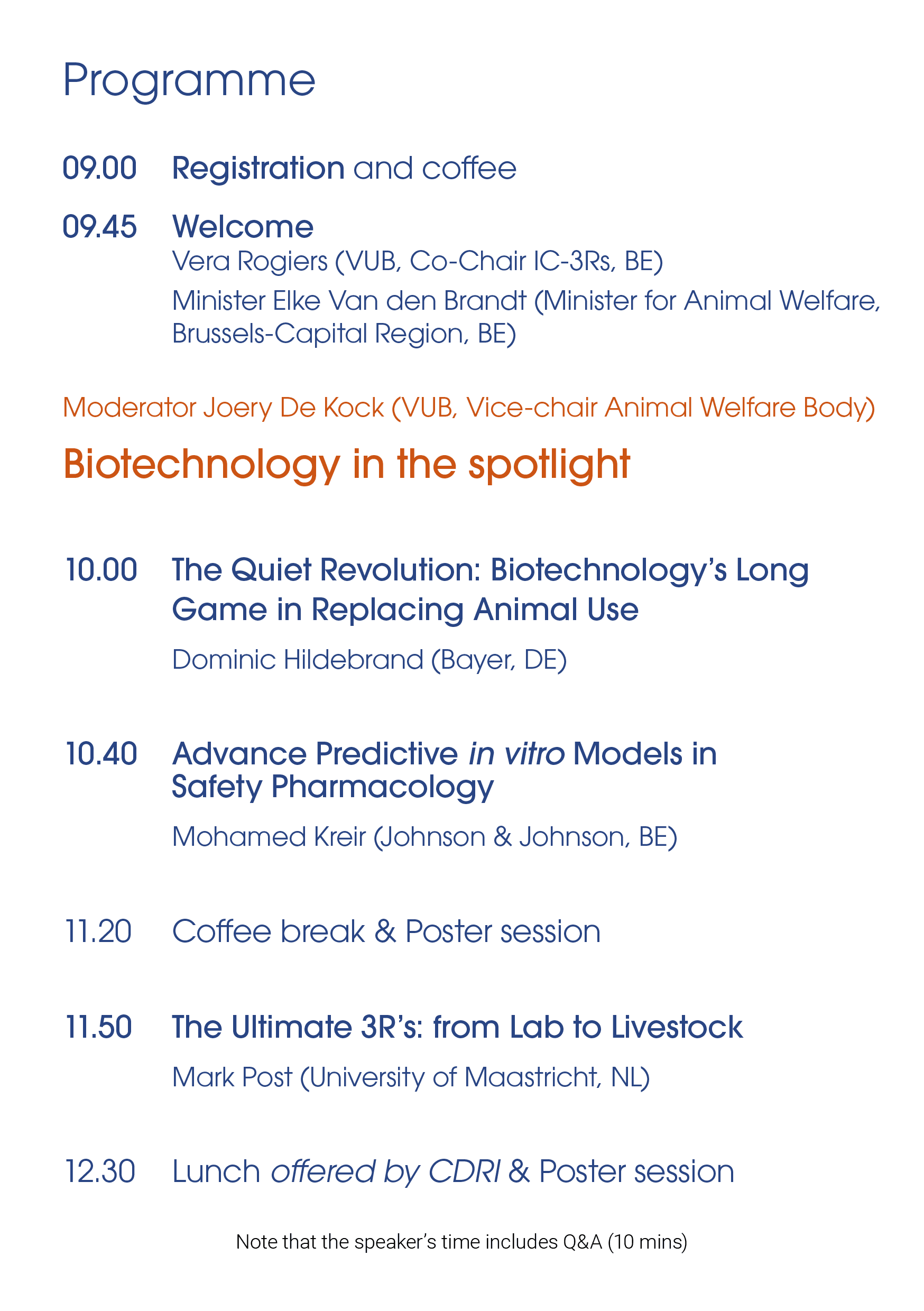
The morning programme places biotechnology in the spotlight and examines how emerging technologies are reshaping innovation and application across sectors. Particular attention will be given to the long-term role of biotechnology in replacing animal use, the translation of these technologies into industrial and market applications, and the broader opportunities and challenges linked to their implementation. The programme will also explore two key applications: the development of powerful biopharmaceuticals and the production of cultivated meat. The latter as a prominent example of how cellular agriculture and tissue engineering can redefine food production while substantially reducing reliance on animals.
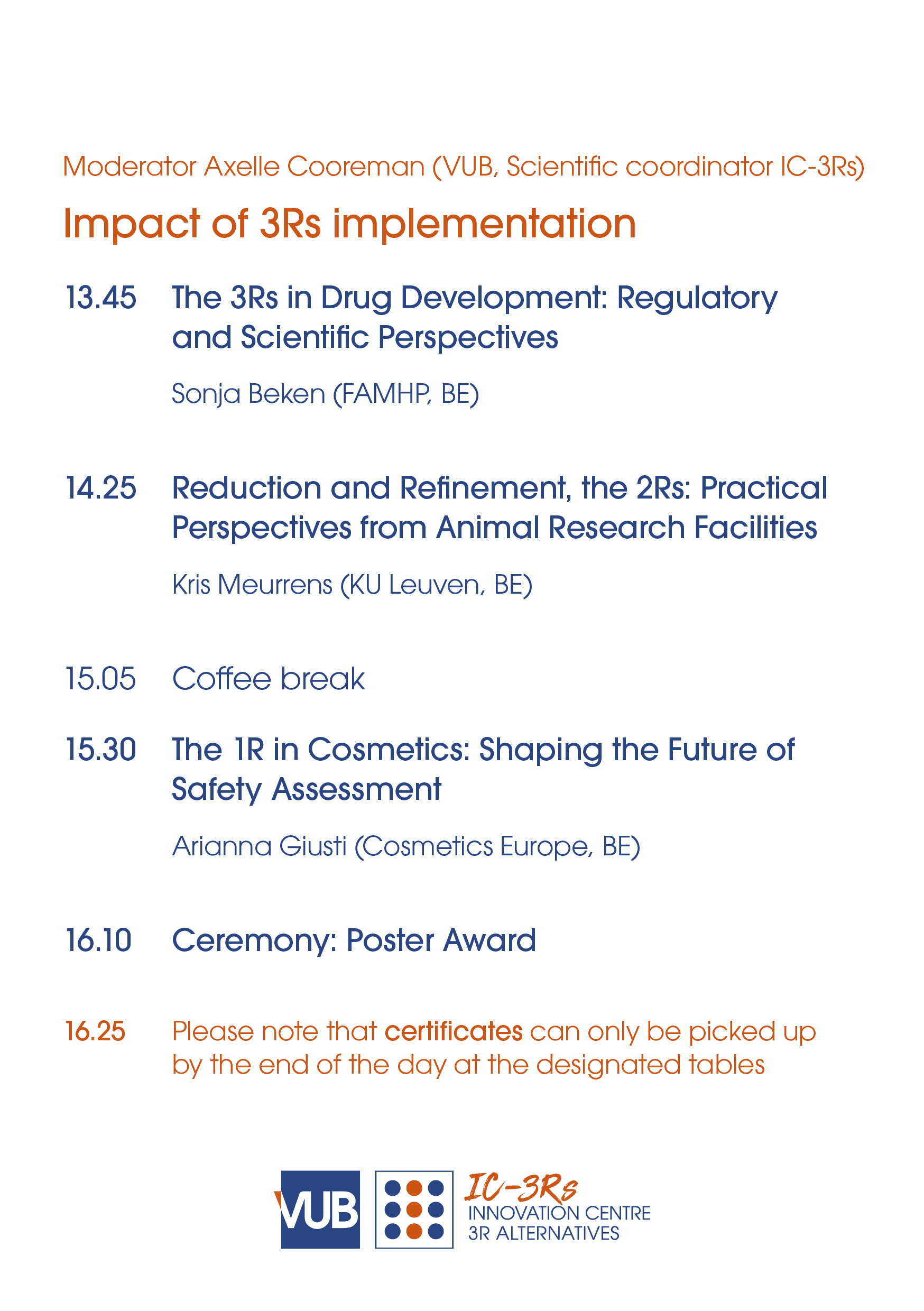
The afternoon sessions focus on the practical impact of implementing the 3Rs across different domains. In drug development, the full 3Rs framework remains essential, as scientific innovation and changing regulatory perspectives continue to support the uptake of alternative methods while refinement and reduction strategies remain necessary in areas where animal studies are still required. Within animal facilities, particular attention will be given to the “2Rs” — Reduction and Refinement — describing how these practices have developed over the years and how continuous improvements in housing, care and experimental design contribute to both animal welfare and scientific quality. Finally, the cosmetics sector will illustrate the concept of the “1R”, where the strong regulatory and societal drive toward complete Replacement has accelerated the development of animal-free safety assessment and innovative non-animal testing approaches.
Overall, the programme reflects how the 3Rs are no longer a niche concept, but a powerful driver of innovation, interdisciplinary collaboration and societal change across disciplines.
Programme of the 2026 Symposium
Our 2026 Speakers
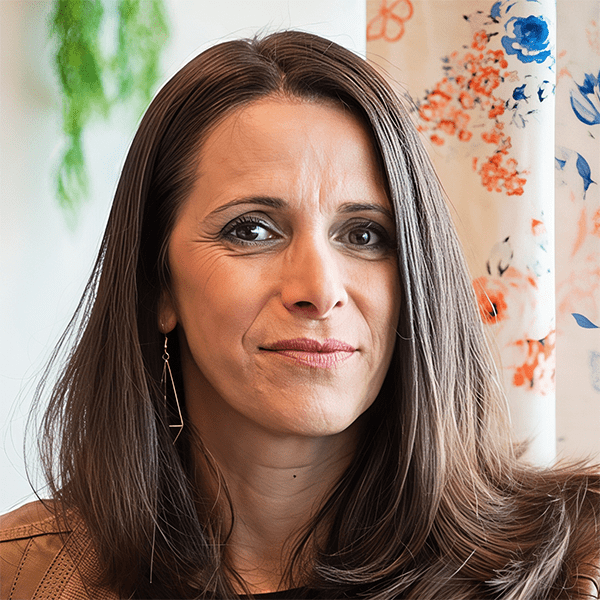
Sonja Beken
FAMHP, BE
Sonja Beken holds a Master in Biological Sciences and Applied Toxicology and a PhD in Pharmaceutical Sciences. She is a European Registered Toxicologist.
Since 2001 she is the Coordinator of the Unit of non-clinical assessors at the Belgian Federal Agency for Medicines and Health Products (FAMHP).
Sonja Beken is Chair of the 3Rs Working Party at the European Medicines Agency (EMA). She acted as ICH Rapporteur for the revision of the S5(R2) Guideline and is member of the ICH S7B/E14 Implementation Working Group and the drafting group of the ICH NAM Reflection Paper.
Sonja Beken contributes to the identification of opportunities for regulatory implementation of 3R testing paradigms and NAMs through her active involvement in large-scale international initiatives.

Arianna Giusti
Cosmetics Europe, BE
Arianna Giusti is Senior Scientific Manager at Cosmetics Europe, where she leads collaborative efforts with external research platforms and organisations, oversees multidisciplinary projects, and focuses on the development and regulatory acceptance of New Approach Methodologies. Her work also covers policy and regulatory aspects related to animal testing. In this context, she co-chairs the Cosmetics Advocacy Priority Team within the International Collaboration for Cosmetics Safety (ICCS) supporting global alignment and acceptance of non-animal methods, and represents Cosmetics Europe in the European Partnership for Alternatives to Animal Testing and in the ECHA Collaborative Platform on Alternatives to Animal Testing. She previously served as Scientific Consultant for ICCS, where she contributed to aligning scientific capabilities, regulatory acceptance, and education programmes with a particular focus on NAMs.
She holds a PhD in Toxicology from the University of Leuven in Belgium, obtained within the Marie Curie Initial Training Network project MarPipe under the Horizon 2020 programme. She previously completed a master’s degree in Molecular Biology and Genetics at the University of Pavia and a bachelor’s degree in Medical Biotechnology at the University of Florence in Italy.
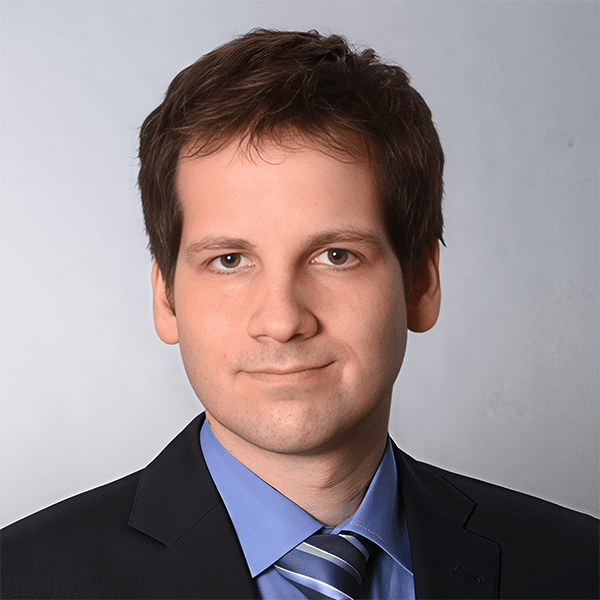
Dominic Hildebrand
Bayer, DE
Dominic Hildebrand is Head of Quality Control for Biotherapeutics at Bayer in Wuppertal, Germany. He joined Bayer in 2013, starting his career in research before moving into quality control for clinical products in 2017. Trained as a biochemist, he earned his PhD in Molecular Medicine through research conducted in Tübingen and Boston. Today, he is actively involved in the development and quality oversight of innovative cell- and gene-based therapies, helping to translate scientific advances into new treatment options for patients.

Mohamed Kreir
Johnson & Johnson, BE
Safety pharmacologist with >15 years of experience in nonclinical safety and translational risk assessment across small molecules and emerging modalities. Expertise in CNS and cardiovascular safety pharmacology, with a strong focus on the development and implementation of human‑relevant in vitro models (including hiPSC‑based neuronal and cardiac systems) and NAMs.

Kris Meurrens
KU Leuven, BE
Dr Kris Meurrens graduated in 1989 as veterinarian at the University of Ghent.
Almost immediately after his veterinary studies he got involved in the management of laboratory animal facilities, meaning that he has more than 30 years experience.
Between 1992 and 2000 he was director of Laboratory Animal Center of University of Leuven (KU Leuven). In 2000 he completed the Master in Laboratory Animal Science at Ghent University.
From 2000 to 2011 he worked as Eurotox-registered toxicologist and veterinarian in an AAALAC-accredited in vivo toxicology contract research facility.
After the closure of that facility he worked shortly in the animal facilities of the Vrije Universiteit Brussels and GSK Biologicals.
In 2012 he returned to KU Leuven as director of Laboratory Animal Center.
He is also the vice-president and treasurer in the Board of the Belgian Council for Laboratory Science, vice-president of the Vlaamse Proefdierencommissie (former Deontological Committee, i.e. advisory committee of the Minister for animal experimentation matters), member of the Steering committee of Re-Place and IC3R-centre VUB and of other lab animal science organisations.

Mark Post
University of Maastricht, NL
Dr Mark Post, MD/PhD, has had several academic appointments at Utrecht University, Harvard University, Dartmouth college, Eindhoven University of Technology and Maastricht University. He currently is professor of Sustainable Industrial Tissue Engineering at Maastricht University. He is visiting professor at Harvard, University of Modena and faculty at Singularity University. His main research interest is the engineering of tissues for various applications. Tissue engineering for Food has led to the development of cultured beef from bovine skeletal muscle stem cells. The same technology is used to culture leather. Dr Post co-authored more than 200 papers in leading peer-reviewed scientific journals and coordinated several national consortia with funding and awards from different sources including government, charity and industry. He is a frequent speaker at international events on innovation in the agrifood sector. He presented the world’s first hamburger from cultured beef in the August 2013 for which he received the World Technology Award from AAAS/Times/Forbes. Dr Post is CSO and co-founder of Mosa Meat and of Qorium, two companies that aim to commercialize meat and leather applications of tissue engineering. Together, these companies have 120 employees, including 50 scientists.
CALL FOR ABSTRACTS
FOR POSTER PRESENTATIONS
You are kindly invited to submit your abstract for a poster presentation at the 9th annual IC-3Rs Symposium 2026. Posters will be displayed during the whole day, poster session is organised during the coffee and lunch breaks.
Abstract topics should focus on the 3Rs Principle in its broadest sense:
- Drug development and research, toxicology, risk assessment …
- Alternative methods and New Approach Methodologies (NAMs) such as organoids, spheroids, organ-on-chip, in silico modelling, omics, NGRA…
- Reduction and Refinement techniques, ethical considerations, legislative aspects…
Attendees who submit an abstract are entitled to a reduced registration fee (€40) for the Symposium. Please indicate it when registering for the event.
POSTER COMPETITION
Young scientists who submit an abstract will compete for the best poster presentation (250€). Anyone working in the field of 3Rs is free to submit an abstract, but only master students, PhD students and postdocs are eligible for the competition.
The members of the IC-3Rs Steering Committee will evaluate the poster presentation and lay-out, of which they will select their favourite poster. The poster award will be attributed at the end of the Symposium.
WHY SUBMIT?
- Present your work to a dedicated audience
- Benefit from a reduced registration fee (€40)
- Young researchers can compete for a €250 prize!
HOW TO SUMIT YOUR ABSTRACT?
- Prepare your abstract (approximatively 2000 characters) using the following template
- Submit your abstract by 15/08/2026 (extended deadline) to abstracts@ic-3rs.org
- After the deadline, we will inform you if your abstract is accepted for a poster presentation
- Don’t forget to bring your poster in A0 (841 x 1189 mm) portrait format at the Symposium (attachment material will be provided for you).
If you have any questions regarding the call for abstracts, please contact us via abstracts@ic-3r.org
Sponsors of the 2026 Symposium
Lunch offered by CDRI